Spring has fully sprung!

Yaaay!! Spring is now in full swing.

And wild edibles are all over the place.

Everywhere I look I see them.

But then again, I’m used to seeing the natural world in terms of “Can I eat that?”

It’s fun finding the edibles that are coming into their own right about now in NJ and PA: greenbriar tendrils, young lambsquarters, and tender dandelion greens to name a few.

And while some very early spring ephemerals are already past their prime, or even completely gone, other treats are taking their place. It’s kind of sad knowing I’ll have to wait until next spring to enjoy bittercress and ramps again, but I relish black locust blossoms that soon appear.

A season for everything!



                                   Black Locust (Robinia pseudoacacia)

There’s only a small window of time to experience this fragrant gift of spring… and that’s now!

Black locust flowers are the only part of this tree that you can eat. So when you decide  to partake, be sure to remove the flowers from the main cluster stem.

To identify Black Locust :

Fragrant white pea-like flowers hang in showy clusters from the tree. Each flower is about 1″ long. The leaves are 7″–18″ long, alternate, and pinnately compound with an odd number of leaflets. The leaflets are oval, and the margins are smooth. Twigs have short, paired, sharp spines, which may be absent in mature trees. The inedible fruit is a thin, flat pod. The bark is brown or gray-brown and deeply furrowed.

Enjoy the flowers raw from the tree, stir a handful into pancake batter, or mix them into a fresh fruit salad.

The flowers taste best when they look best, and haven’t wilted yet.

                                                            *        *         *              
violet

                                                          Wild Violets (Viola spp.)

Violet flowers are fun to eat and are rich in rutin, a bioflavonoid that strengthens capillary walls. Their time to shine is mid-April through early May.

But you can still make good use of the foliage. Violet leaves offer a healthy dose of vitamin C, and can be eaten raw in salads or cooked like any leafy green. Or brew up a tasty cup of violet leaf tea from the fresh or dried leaves.

To identify Wild Violets:
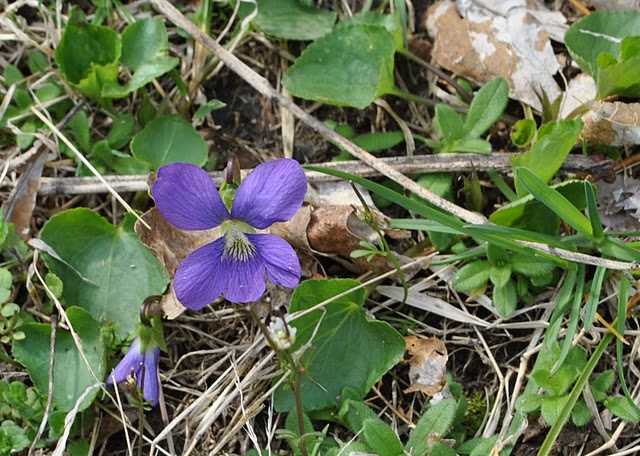
The leaves are heart-shaped with a scalloped border, and they sit atop a single, thin stem. The flowers are bilaterally symmetrical, with 2 upper petals and 2 side petals; the lower petal is marked with veins and forms a spur. The young leaves are partially curled, and unfurl themselves as they get bigger.

A word of caution: Some sources warn about larkspur (Delphinium spp.) and monkshood (Aconitum) as poisonous look-alikes of violets. As with ALL wild edibles, you should really know each plant before you put it in your mouth. Familiarize yourself with wild violets when they are in bloom; waiting until they flower makes it easier to get to know this plant and make a positive ID.

                                                                 *        *         *         
greenb

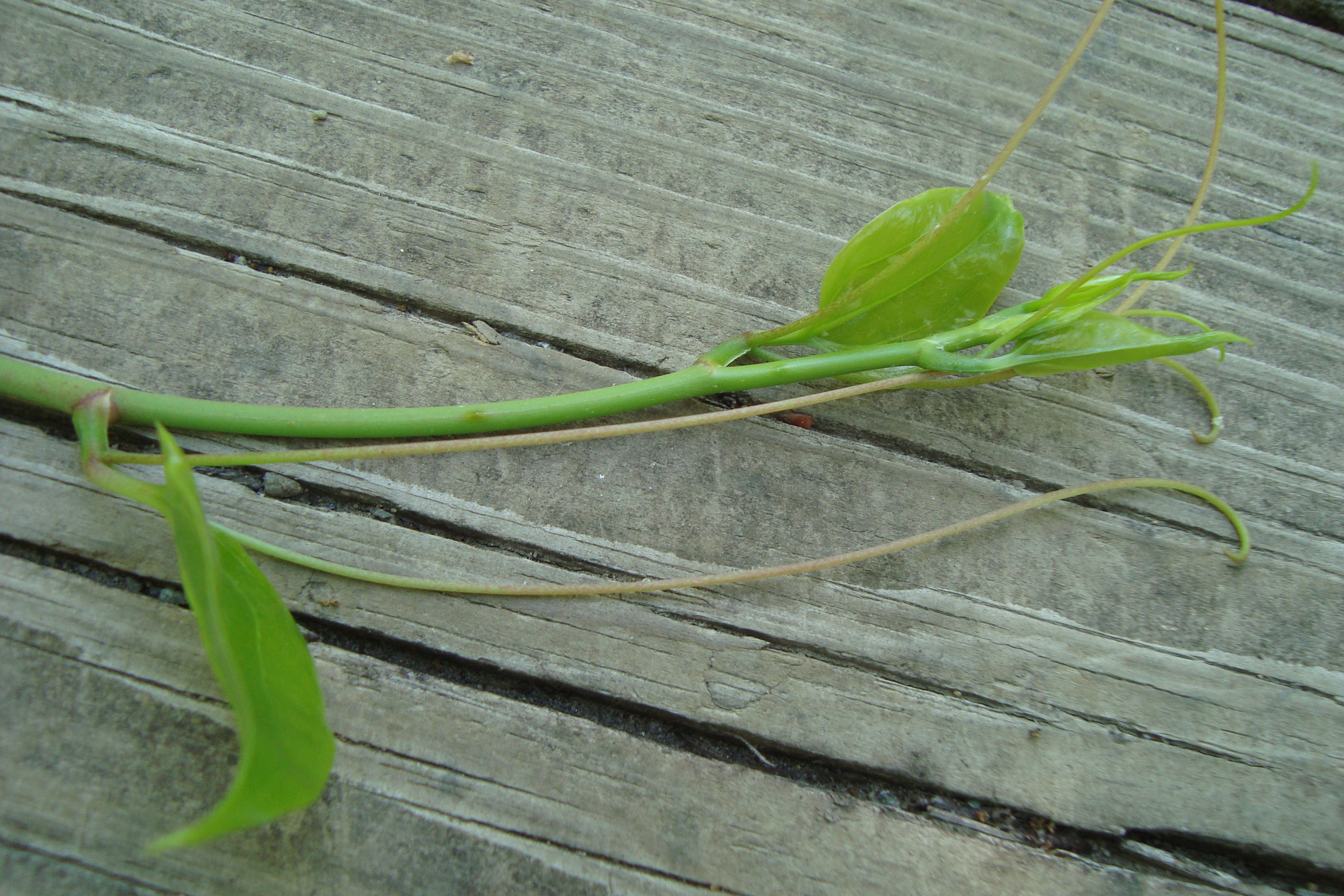
                                        Common Greenbrier  (Smilax rotundifolia)

Who would ever guess that this terribly thorny shrub could bear such tender spring growth?

Available in spring and no other time, the beautiful soft tendrils of this plant make a great trail nibble.

At this time of year, the young tips of the vine haven’t hardened off yet and are soft and pliable. Just snap off the ends, and whatever easily breaks off is good to eat.

To identify Common Greenbrier:

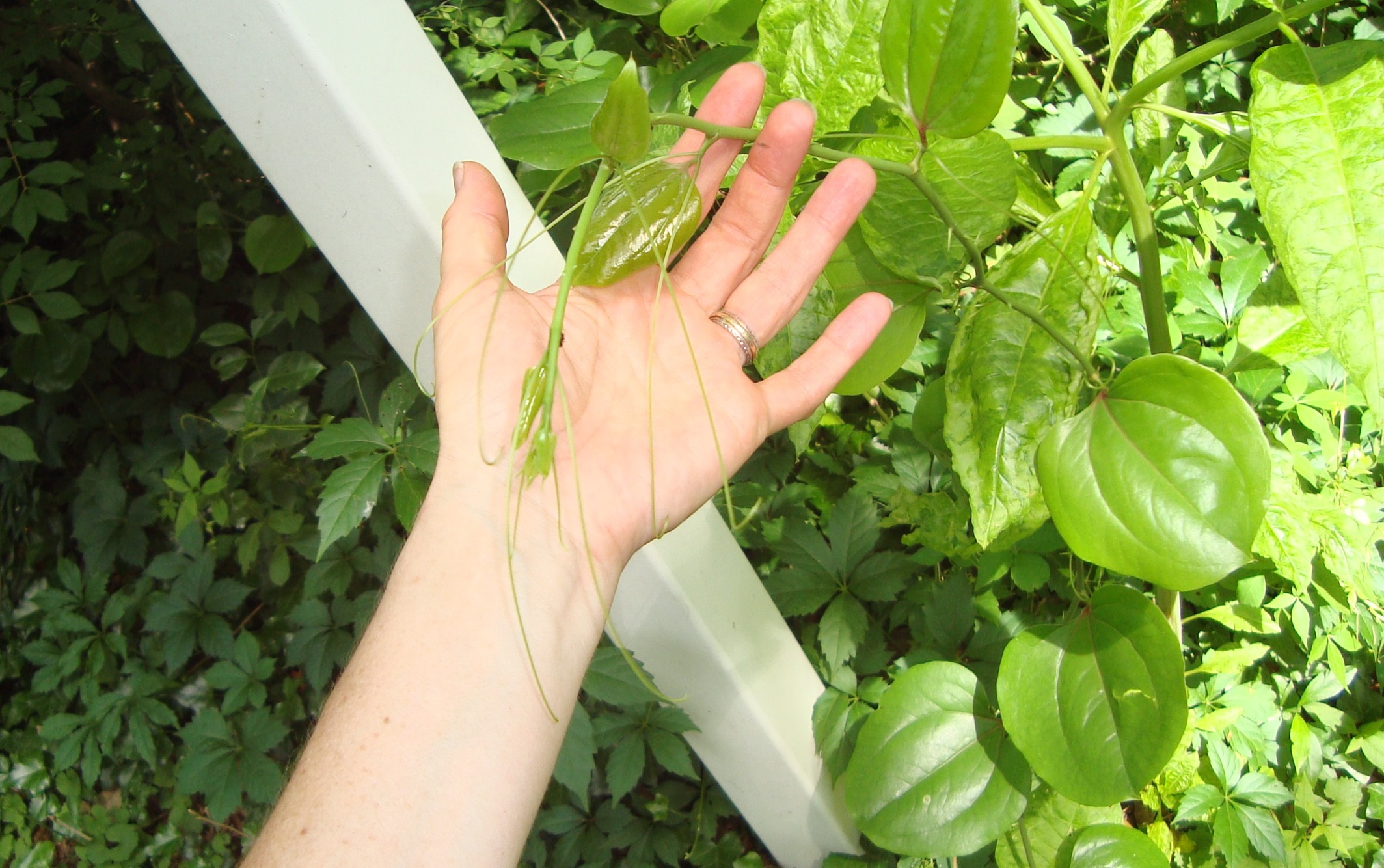
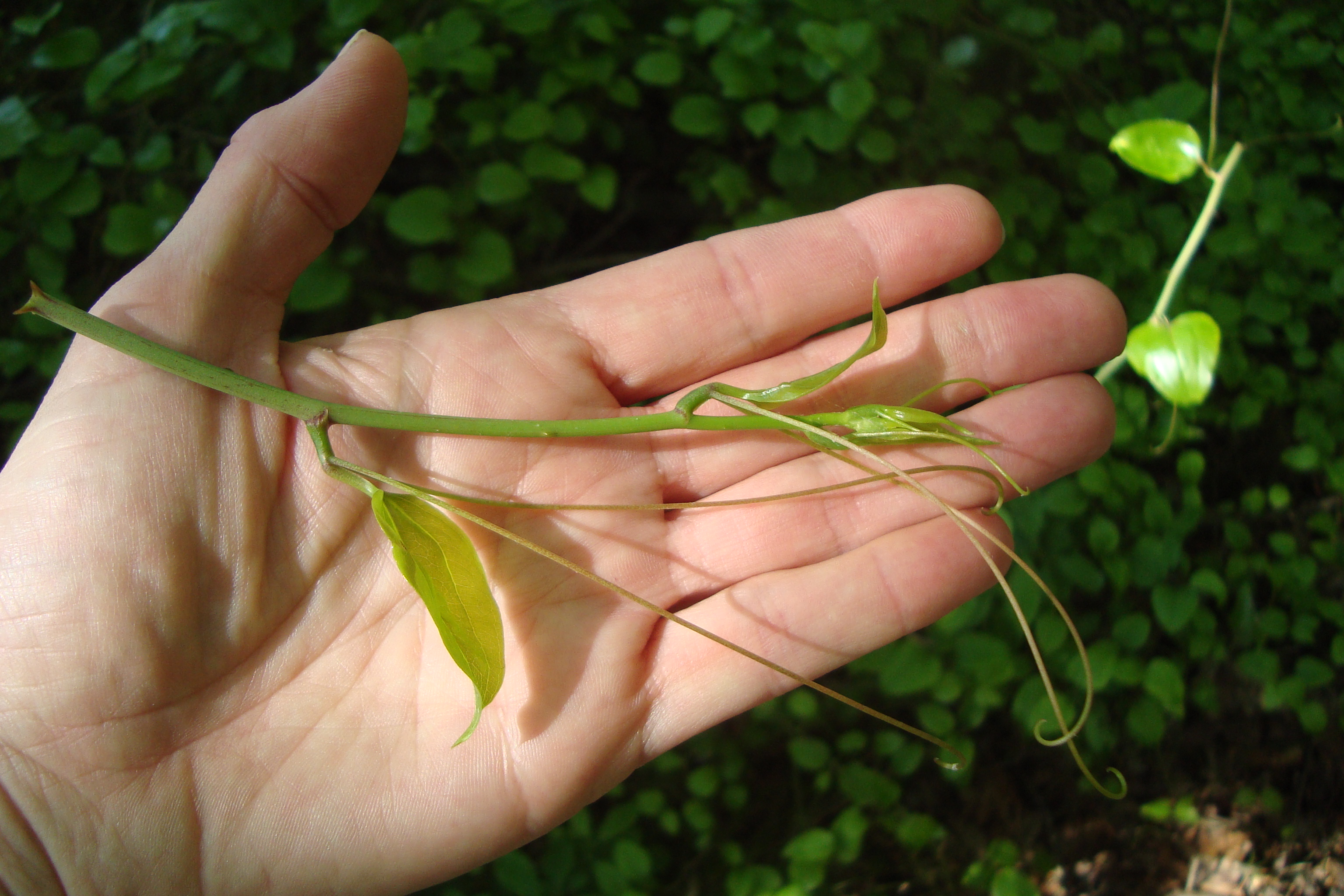
The vine has thorns, climbing tendrils, and shiny heart-shaped leaves with smooth edges. The leaves have 3-5 parallel veins which radiate out from the base.
Green brier

Someone once told me this part of the plant looks like a praying mantis.  It does, doesn’t it?  I’d much rather eat the greenbrier though!

                                                                 *        *         *         
dandelion DSC08843

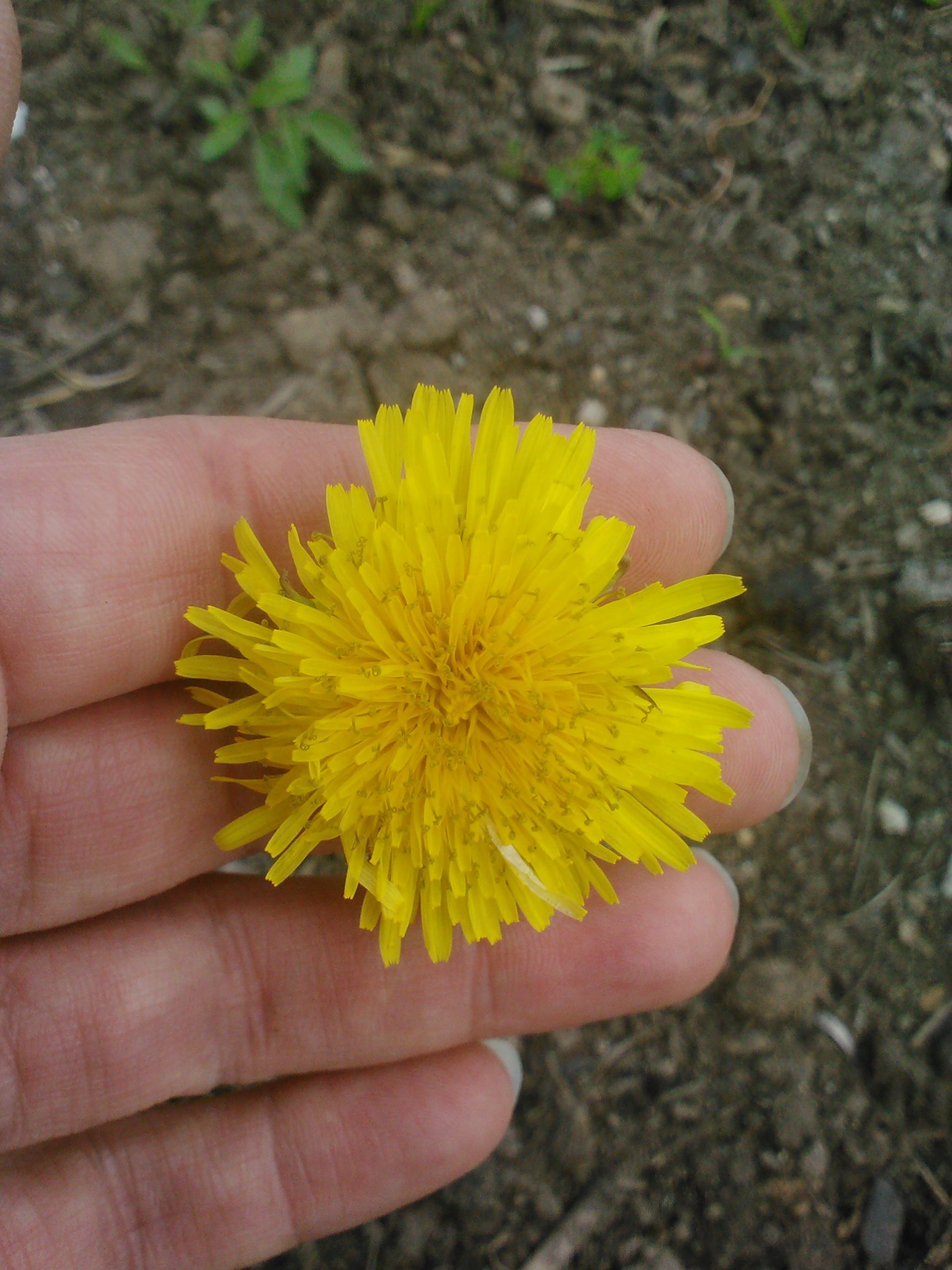
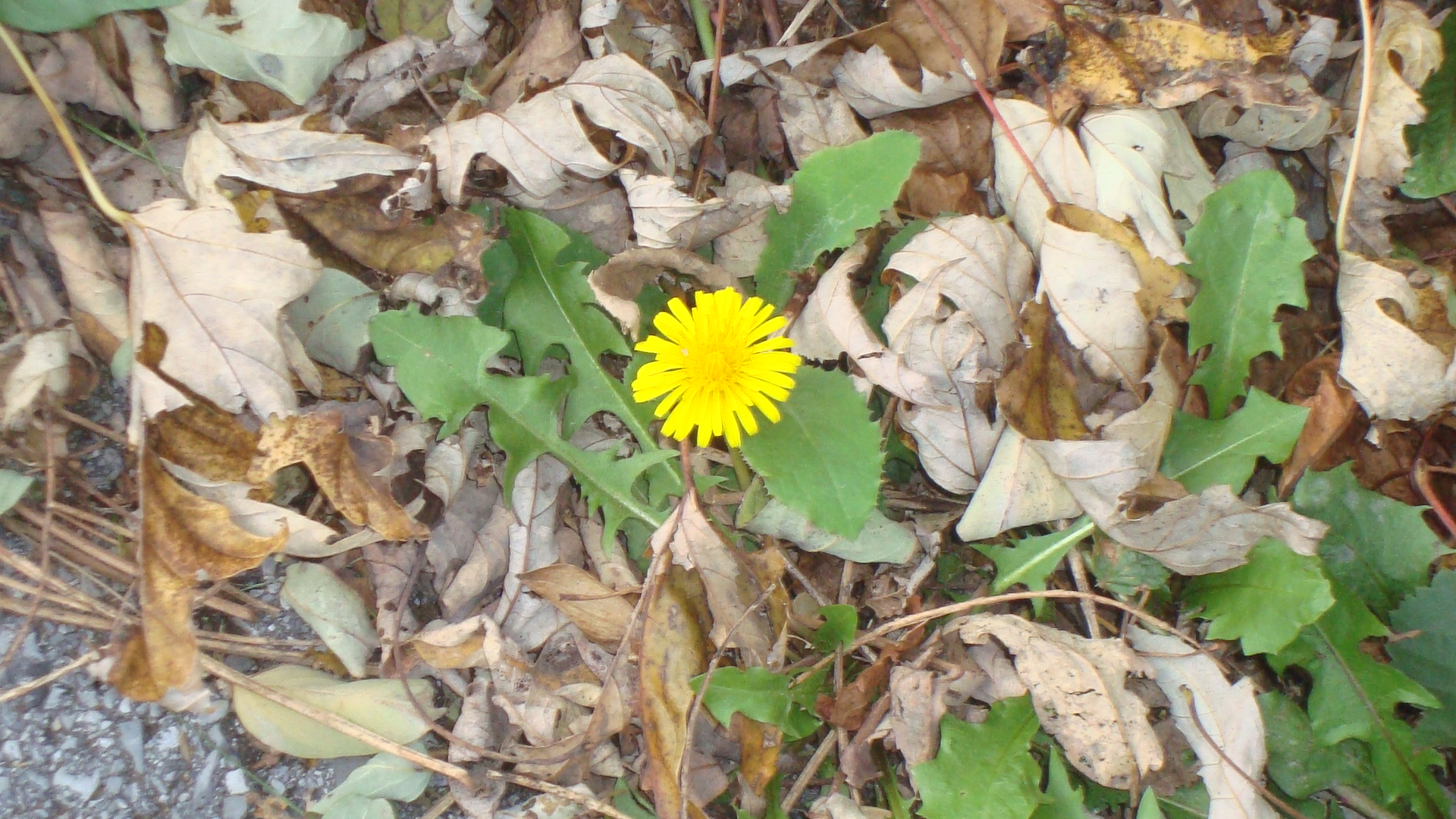
                                                     Dandelion (Taraxacum officinale)

Pesky weed or culinary delight? Super nutritious and available everywhere, dandelions are an under-appreciated wild treasure.

The spring leaves are tender and delicious. Eat them raw in salads.

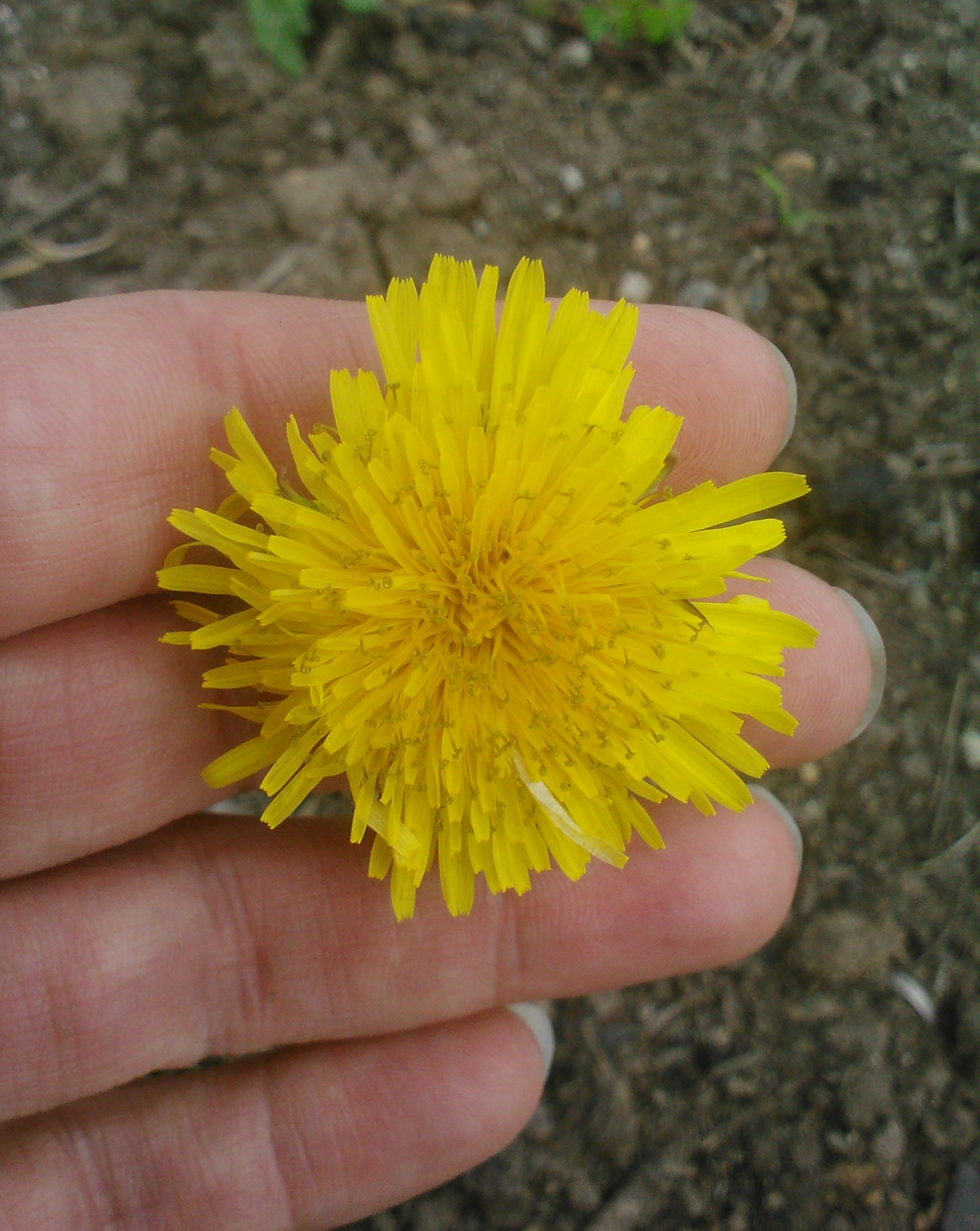
Pick a flower and just eat it!  Usually I blow on it first to scare any little bugs from their hiding places.

With older dandelion leaves, you can take a bite first to see how it tastes to you. If the degree of bitterness is beyond your liking, you can boil them first for a milder “mess of greens”.

To identify Dandelion : 

The leaves are in a basal rosette, up to 10″ long, shallow to deeply toothed. The teeth usually point backwards. The stalk is leafless, smooth, hollow, and unbranched, with a milky sap when broken. There is only one yellow flower per stalk. Bloom time is April–May. Seed head is familiar puffball. Long taproot.
dand

Here’s a nice recipe for the flowers:

Flowery Fritters

Collect dandelion flowers.  Make a batter, beating together one cup of milk, one egg and a cup of flour. Heat a few tablespoons of olive oil in a skillet over medium heat.  Dip each flower into the batter and put into the hot oil. When golden brown, turn. Remove to paper towels to drain. Garnish with powdered sugar, honey, etc.

Dandelion has several “look-alikes”. Most do not pose a problem since they also happen to be edible. One however, is similar in appearance to dandelion and should be avoided. This is coltsfoot (Tussilago farfara). Although it’s been ingested in various ways for centuries, coltsfoot may have some toxic properties.  So make sure you positively identify your dandelions!

                                                                       *        *         *       
DSC07529 yellow wood sorrel  

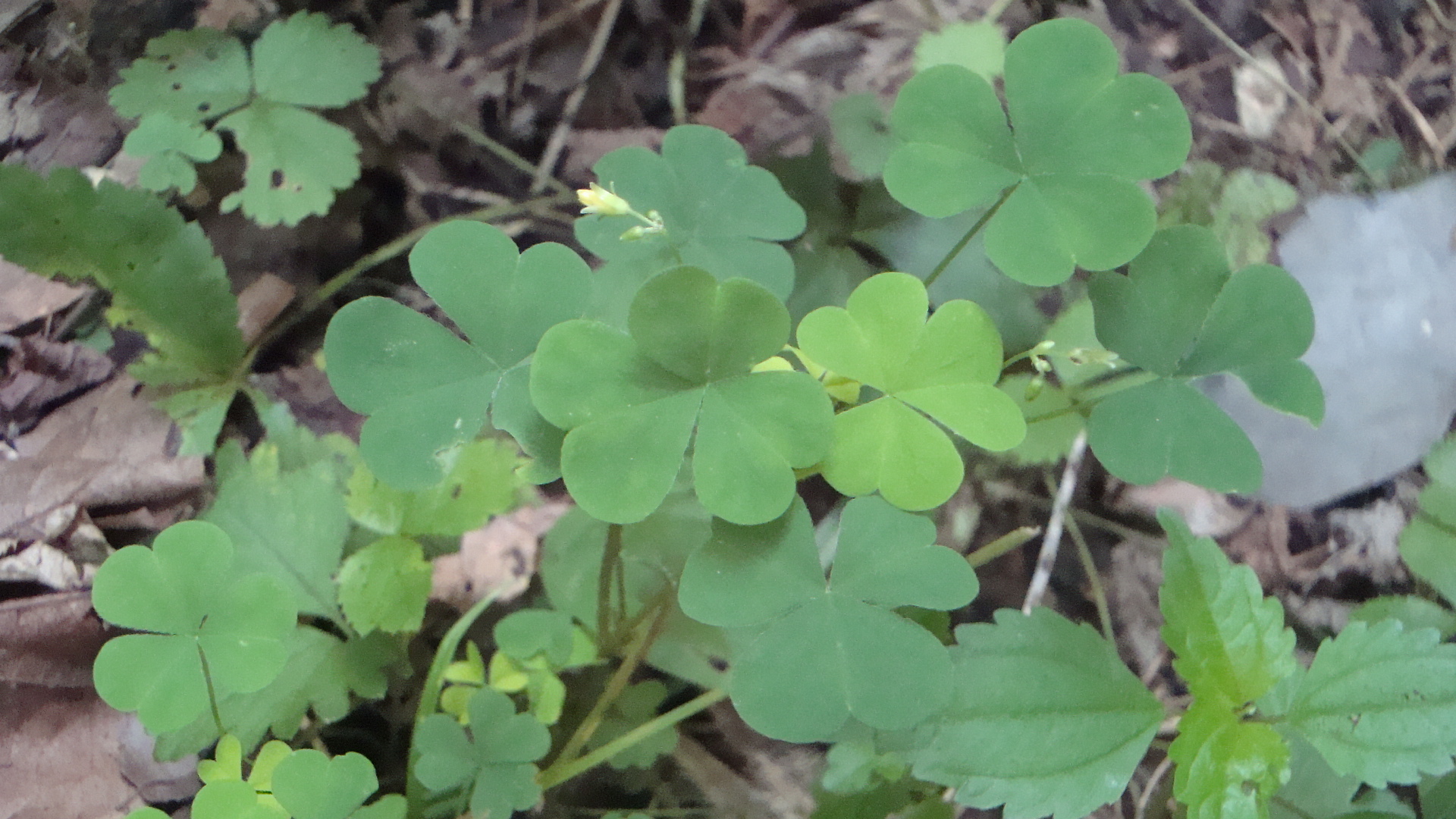
                                                      Yellow Wood Sorrel (Oxalis stricta)

I can always count on this one to elicit reactions of pleasant surprise from just about everyone. Wood sorrel has a tart lemon-like flavor all its own. Nibble it as you find it, or bring home a handful and add to your dinner salad for a bright lemony lift. The leaves, yellow flowers, and seedpods are all edible with a great lemony zing.

If you’ve been told to limit foods like spinach or beets due to a medical condition such as kidney stones, you can put wood sorrel in the same category of oxalic acid-containing foods. Most people can enjoy the plant in moderation.

To identify Wood Sorrel:

Upright or sprawling plant, up to 8″ tall. Leaves on long petioles, palmately compound with 3 heart-­shaped leaflets. Each leaflet creased down the middle; edges are untoothed. Flowers are yellow, 5-petaled, radially symmetrical, about 1/2″ across, They bloom spring through summer. Fruits are upright green seedpods, up to 1″ long, on a sharp angle from the stem.   

Waiting on Spring

Winter is a challenging time for foragers, but there’s something uniquely satisfying about finding wild edible plants even on a frosty day. While I might not be willing to remove my mittens in order to pluck a handful of greens, it’s nice knowing that I could bring home the makings of a winter wild salad if I wanted.

You may think that foraging on these coldest of days would yield precious little in the way of edibles.   What exactly can you find out there? And with snow blanketing the ground?!

But even before the fresh wild greens of spring have popped, there’s food to be found.

Think of it as a cold weather treasure hunt. While you may need to look a little bit harder, you’ll find that nature still provides bountiful surprises.

 ………………………………………………………………………………………………………………………………………………………………..

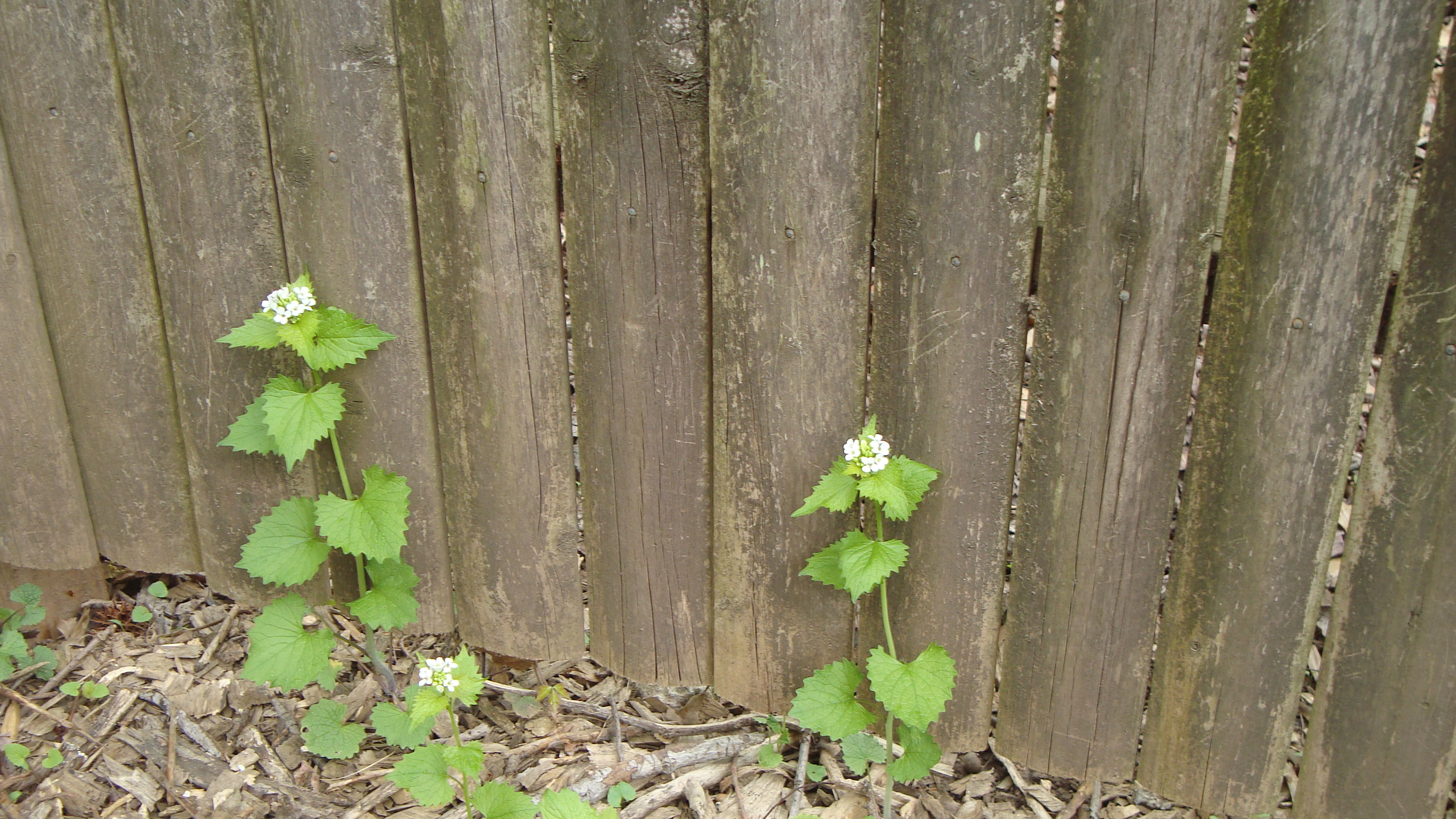
 Garlic Mustard (Alliaria petiolata)

garlic mustard in snow

 Happily photosynthesizing… in February!

Seriously invasive in natural areas throughout the northeast, garlic mustard is a most delicious weed.

The oldest known herb to be used in Europe, garlic mustard was brought over in the 1800s as a favored vegetable. It eventually jumped the garden fence and has since really made itself at home in our woodlands and other moist, shady places.

Too bad that it’s kind of a bully, overwhelming and displacing our native spring wildflowers. It’s such a tasty and nutrition-packed vegetable that I really wish it didn’t have such a bad rep botanically.


winter garlic mustard - Copy

Look for kidney-shaped leaves with scalloped edges, and the smell of garlic when crushed.

To identify Garlic Mustard:

Biennial plant with simple, unlobed leaves. First-­year basal rosette has round or kidney-­shaped leaves with scalloped edges. Can stay green through winter and resume growth in spring. Second year produces a flowering stalk, 2’–3′ tall with pointed, heart-­shaped, sharply toothed leaves, alternate on the stem. Small white, 4-petaled flowers. Seedpods are long, thin, and 4-sided with tiny black seeds. White taproot. All parts of the plant smell of garlic when crushed.

The whole plant is edible – all parts, raw or cooked. The leaves are tastier before the flowers form. Come summer, you can eat those flowers.

Garlic mustard seeds have been used as a spice since the days of early European hunter-gatherers. The roots taste like horseradish and can be prepared in a similar fashion.

And the plant is cruciferous. That puts it in the same super-hero family as broccoli, kale and the other protective, cancer-fighting veggies. What a plant.

Add it to your salad for a garlicky hit, or cook it as you would other tender greens, like spinach.

garlic mustard

In summer, leaves become triangular and more toothy, and white flowers appear.

………………………………………………………………………………………………………………………………………………………………..

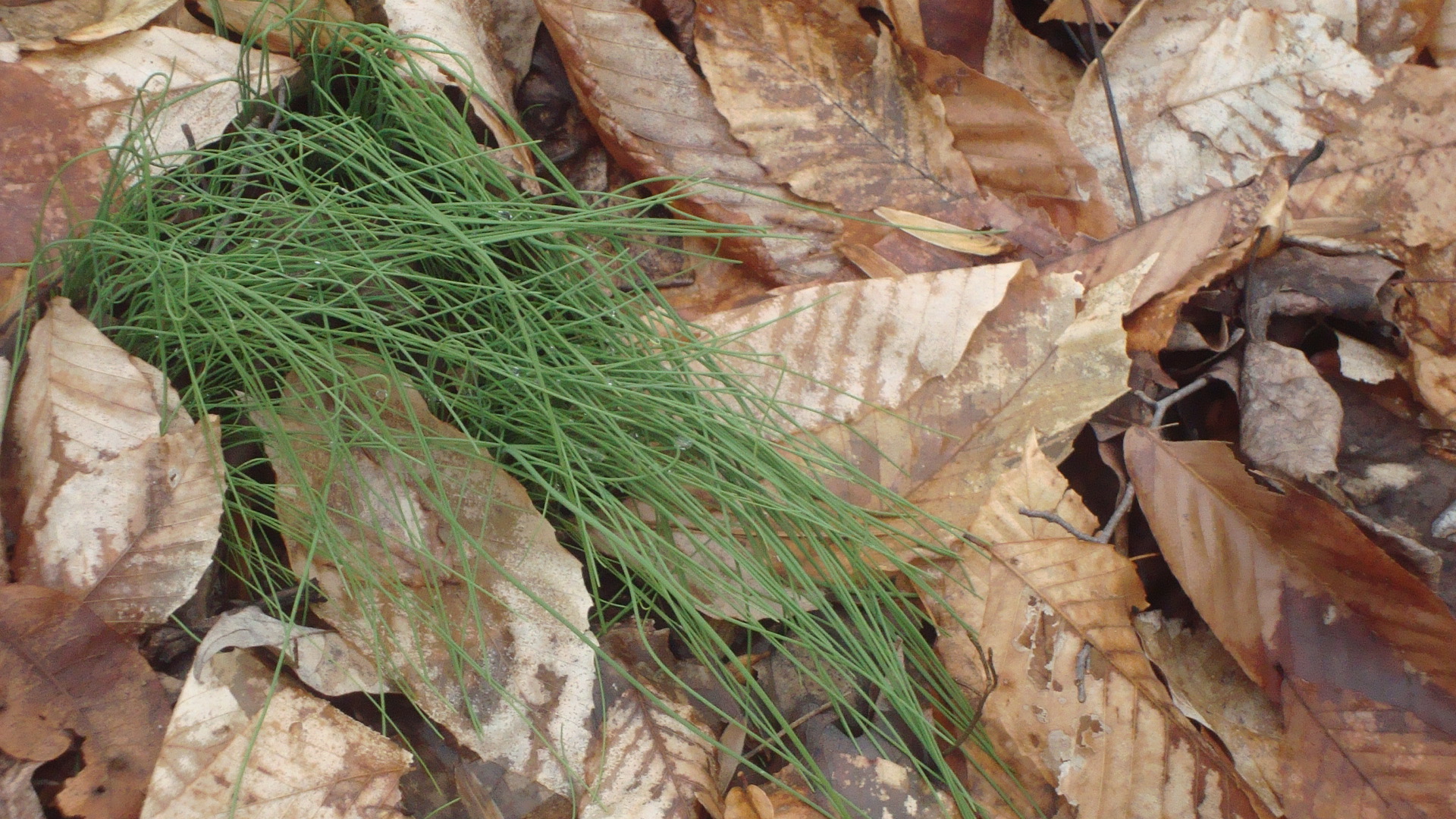
Wild Garlic (Alium vineale)

This plant thrives pretty much throughout the winter.

For positive ID, look for the hollow chive-like leaves, and sniff for a definite garlicky smell. Then snip some and sprinkle as a garnish on soups, or blend into cream cheese (yum!) or mashed potatoes. Use wild garlic anywhere you’d use scallions or chives.

To identify Wild Garlic:

Leaves are long, thin, round, and hollow, up to 18″ long. They usually grow in clumps. Entire plant has strong garlic or onion smell when crushed. Purplish flowers form at the top of a central stem; flowers may be replaced by aerial bulblets. Underground bulbs are white, round to oval, with a papery skin.

garlic

Wild garlic is a member of the Allium family, which hosts a slew of healthful constituents. Included in the list of potential benefits are antibiotic and anti-inflammatory properties, improved heart health and protection against some cancers.

And most of the benefits are present in both raw and cooked form. So enjoy nibbling wild garlic whenever you find it. Garlic breath may be a small price for the payback.

 ……………………………………………………………………………………………………………………………………………………………..

Wild Strawberry (Fragaria spp.)

Now how about a nice hot cup of strawberry leaf tea – doesn’t that sound inviting?

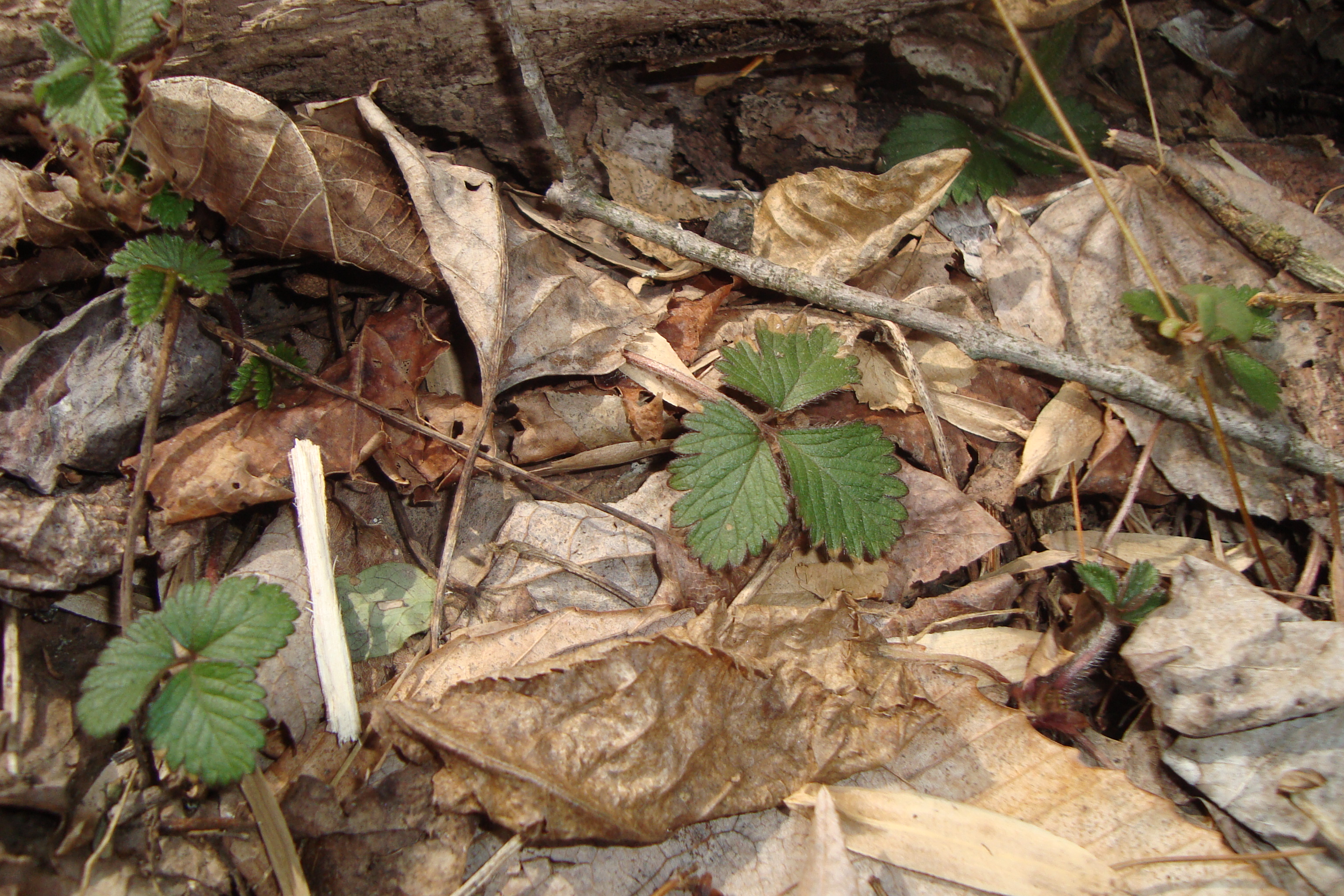
Wild strawberry leaves make a nice, mild caffeine-free tea. And while it may not taste of the fruits of summer, the brew has its own pleasant character.   On your next woods walk, scan the brown leaves of the woodland carpet and you’ll likely discover wild strawberry leaves.

DSC05901

Wild strawberry in winter – move leaves around and you’ll  find more hiding below.

Fairly easy to identify with their familiar coarsely-toothed leaflets in groups of three, the leaves look very similar to your garden-variety strawberry. You may even find them peeking through a cover of snow.

To identify Wild Strawberry:

Look for a ground-­hugging plant with leaves consisting of 3 leaflets, coarsely toothed. Flowers are white with 5 petals. Fruit are quite small, and red when ripe. Seeds are sunken into surface of the flesh. Plant spreads by runners, which root to form new plants.

Gather up a handful of the fresh leaves, and use 1/4 cupful for each mug of boiling water.

Wild strawberry does have a look-alike. Indian or mock strawberry (Potentilla indica) can be difficult to tell apart from true strawberry without flowers or fruit to help in identification, but not to worry… they both make a pleasant pot of tea.

winter strawberry leaves

……………………………………………………………………………………………………………………………………………………….

Dandelion (Taraxacum officinale)

Everybody knows this plant. And even though the flavor of dandelion leaves is milder when young, I’ve tasted some surprisingly acceptable ones in the dead of winter. Nibble on a leaf to check its bitterness quotient, and then take it from there.

Once in a while you’ll even find a flower. But since they’re kind of scarce in winter I like to leave them for others to enjoy their radiating yellow sunshine.

The entire plant is edible. The roots are sometimes roasted and used as a coffee substitute. The jagged, pointed teeth on the leaf edges gave rise to the name. Dandelion comes from the French “dent de lion” or “teeth of the lion”.

To identify Dandelion:

The leaves are in a basal rosette, up to 10″ long, shallow to deeply toothed. The teeth usually point backwards. Smooth, hollow unbranched, leafless stalk, milky sap when broken. One yellow flower per stalk, bloom time is April–May. The seed head is the familiar puffball, and the plant has a long taproot.

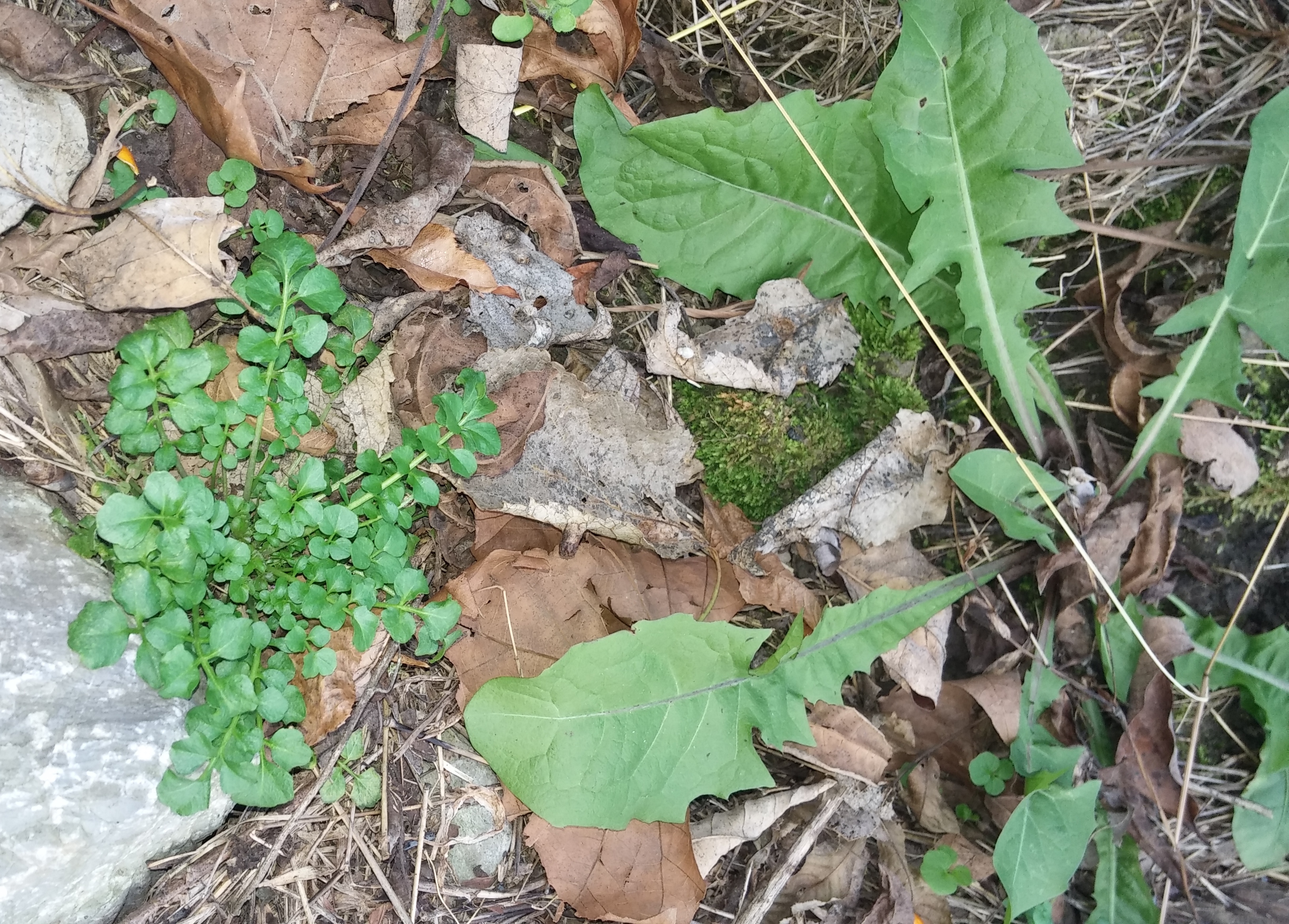
cress and dandelion - Copy

 Dandelion, alongside some bittercress (also waiting to be eaten!)

………………………………………………………………………………………………………………………………………..

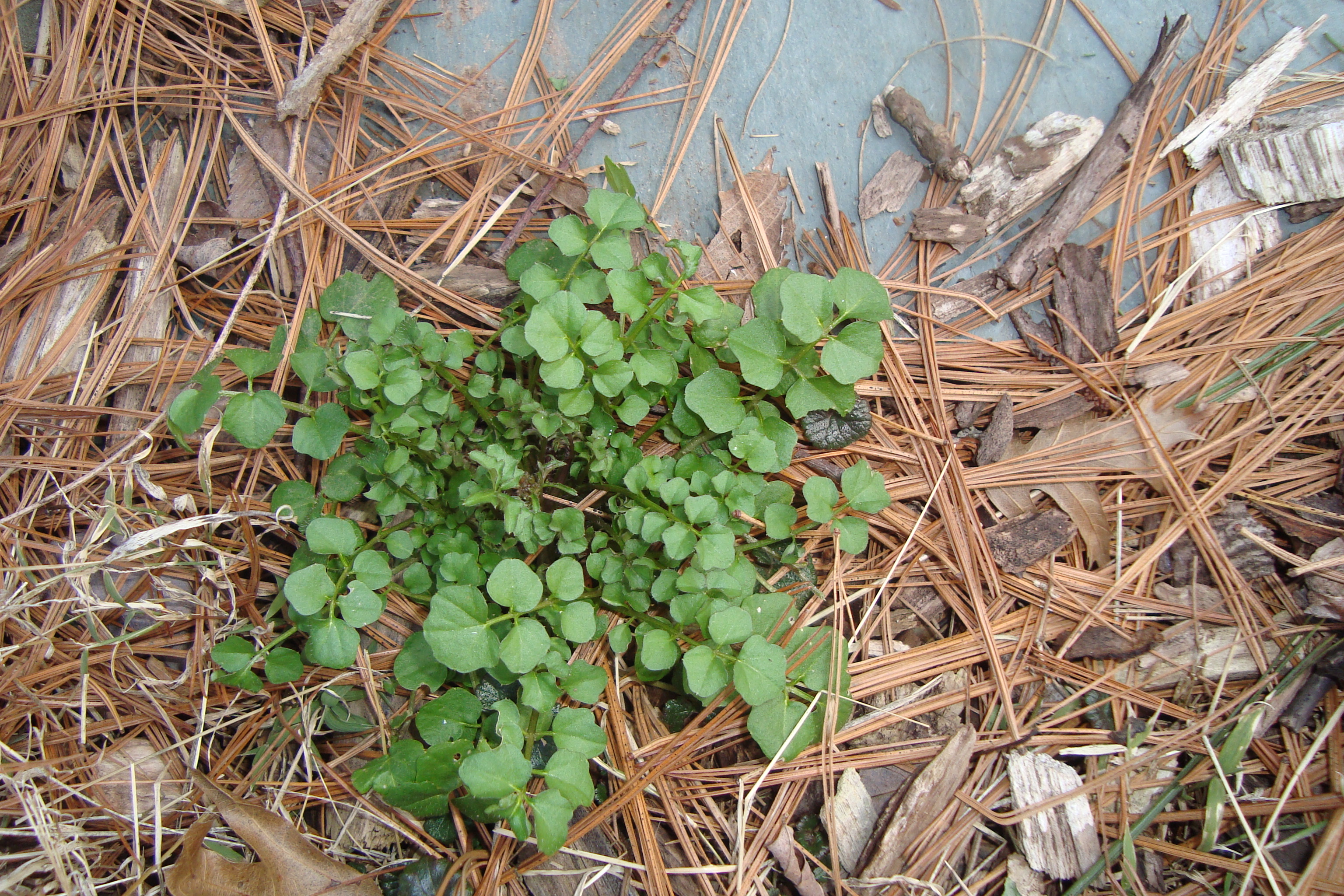
Hairy Bittercress (Cardamine hirsuta) 

somekindacress in March

You may know this as the weed plaguing your garden beds.

This invasive “weed” can be found almost anywhere and is a terrific edible. Unfortunately named, hairy bittercress is hardly bitter, and it really isn’t hairy. Its pleasant, slightly peppery flavor is similar to its near relatives, watercress and arugula.

Full of nutrition, it’s another of those health-protective, cruciferous veggies. Pick the stems and leaves and enjoy them as you find them, or take some home to add zip to your dinner salad.  The whole above-ground part of this plant is good eating.

To identify Hairy Bittercress:

Look for leaves growing in a dense basal rosette radiating out from a central point. Each stem is a leaf with multiple leaflets arranged in opposite pairs. Leaflets are small and rounded; the terminal leaflet is the largest. Leaves are sparsely hairy. Flower stalk arises from the center of the rosette bearing small clusters of tiny white, 4-petaled flowers that become thin, erect seedpods. When mature, the pods explode at the lightest touch, sending seeds up to 6′ away.

Wild Edibles of Spring

Our ancestors saw early spring greens as a welcome sight indeed. Weary of a long monotonous winter diet of stored foods and little or no fresh vegetables, wild spring edibles were much prized.

Even though most of us today don’t rely on wild food for sustenance, it’s still easy to appreciate wild edible plants. Tasty and loaded with nutrients they are, in many instances, superior to store bought veggies.

Generally, we can anticipate wild greens (leaves) as the first to pop up, followed by harvests of flowers, berries and other fruits.

With so many springtime edibles out there, it’s hard for me to choose favorites, so let’s start with one familiar to most of us – the dandelion!

Dandelion (Taraxacum officinale)
Pesky weed or culinary delight? Super nutritious and available everywhere, dandelions are an under-appreciated wild treasure. If you’re only going to learn a few wild edible plants, this should be on your short list.

Why? For starters, the entire plant is edible.

In spring, the leaves are tender and delicious. Eat them raw in salads or cook them as you would any leafy green. If you appreciate a little bitterness in your greens, you’ll like young dandelion leaves.

The little flower buds, tight and round, are my favorite part. Look for them at the base of the dandelion plant. They’re also on the rising flower stems, but best when still tightly closed.

Later in the growing season the leaves can still be eaten, but you’ll probably want to boil them to remove some of the bitterness.
Full-blown, yellow dandelion flowers are also edible. I have found so many people amazed to hear this fact. I like to pick the flowers and eat them while weeding my veggie patch. I usually blow on them to scare out any bugs – not always necessary but makes me feel better!

Another reason to make your acquaintance with this plant – dandelions are super nutritious! They are a very good source of calcium, beta-carotene (the superior, plant source of vitamin A), vitamins C and E and many antioxidants.

HOW TO IDENTIFY
Sun-shiny bright yellow dandelions are probably the most commonly recognized wildflower.

The jagged, pointed teeth on the leaf edges gave rise to the name. Dandelion comes from the French “dent de lion” or “teeth of the lion”. The leaves are in a basal rosette, up to 10″ long, shallow to deeply toothed. The teeth usually point backwards. Smooth, hollow unbranched, leafless stalk, milky sap when broken. One yellow flower per stalk, bloom time is April–May. Seed head is familiar puffball. Long taproot.

dand

CAUTIONS

As familiar as they are to most of us, dandelions do have several “look-alikes” that can result in mistaken identity.
Most of these do not pose any problem although you should always be careful with plant identification.
Cat’s-ear (Hypochaeris spp.) and hawkweed (Hieracium spp.) have dandelion-like flowers, and chicory (Cichorium intybus) and wild lettuce (Lactuca spp.) have similar toothy leaves.

One look-alike that should be avoided is coltsfoot (Tussilago farfara). With a flower similar enough to be confused with dandelion, coltsfoot may have some toxic properties. Even though it has been used medicinally for centuries, coltsfoot is no longer considered harmless, and it may cause liver damage. So make sure you positively identify your dandelions.

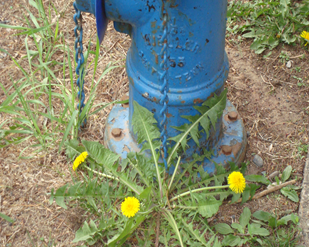
And, as I always remind folks, be careful to forage from “clean” places, in order to avoid pesticides, auto exhaust, and other undesirable contaminants.

sasha hydrant

Be careful of location!


Common Violets (Viola species)

Roses are red, violets are blue… and they are amazing!
You may be lucky enough to have violets punctuate your lawn in the spring. If so, don’t hesitate to nibble on a few of these little lovelies. Both the leaves and flowers are edible and so good for you, providing hefty doses of vitamins A and C.

Eating the flowers provides a special benefit. Violet flowers are rich in something called rutin. This protective bioflavinoid is an antioxidant with potent anti-inflammatory properties. Many countries sell and use rutin supplements to strengthen capillaries and treat hemorrhoids and varicose veins. Recent studies show strong evidence that rutin may prevent blood clots, thereby reducing risk of heart attacks and strokes.

The showy flowers are impressive as a garnish atop a cake.  Or use them as a surprise salad ingredient.  There’s a whole lot of “wow” in this little flower!

violet

While violet flowers may be a springtime delicacy, the leaves can be enjoyed for months beyond their spring appearance. And unlike dandelion and some other wild greens, violet leaves do not get bitter with age. Enjoy violet leaves brewed into a good tasting tea, or cook up a bunch for a mess of mild cooked greens.

HOW TO IDENTIFY
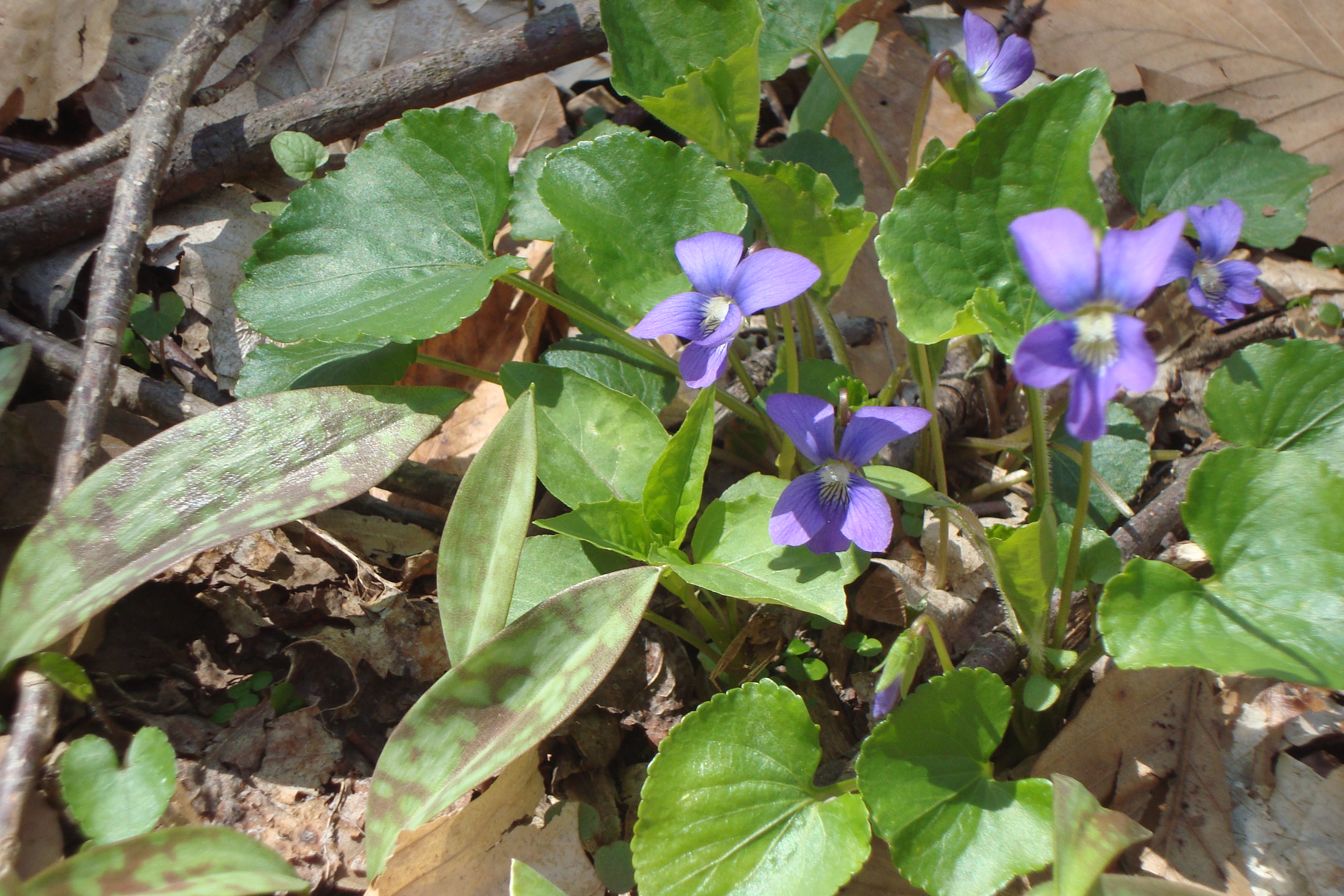
There are many species of wild violets, and all members of this group can be eaten. One of our more familiar wild flowers, the leaves are heart-shaped with a scalloped border, with each leaf perched on top of a single, thin stem. The flowers are bilaterally symmetrical, with 2 upper petals and 2 side petals; the lower petal is marked with veins and forms a spur. The young leaves are partially curled, and unfurl themselves as they get bigger.
Gather them from your organically grown lawn or any safe, wild place.

violet w trout lily

Note the heart-shaped leaf and the scalloped border.

CAUTIONS
Some sources warn about larkspur (Delphinium spp.)  and monkshood (Aconitum) as poisonous look-alikes of violets. While I personally don’t see these plants as all that similar to violets, I can see the reason for caution. So, as with ALL wild edibles, I encourage you to really know each plant before you put it in your mouth.
Familiarize yourself with wild violets when they are in bloom; waiting until they flower makes it easier to know this plant and make a positive ID.

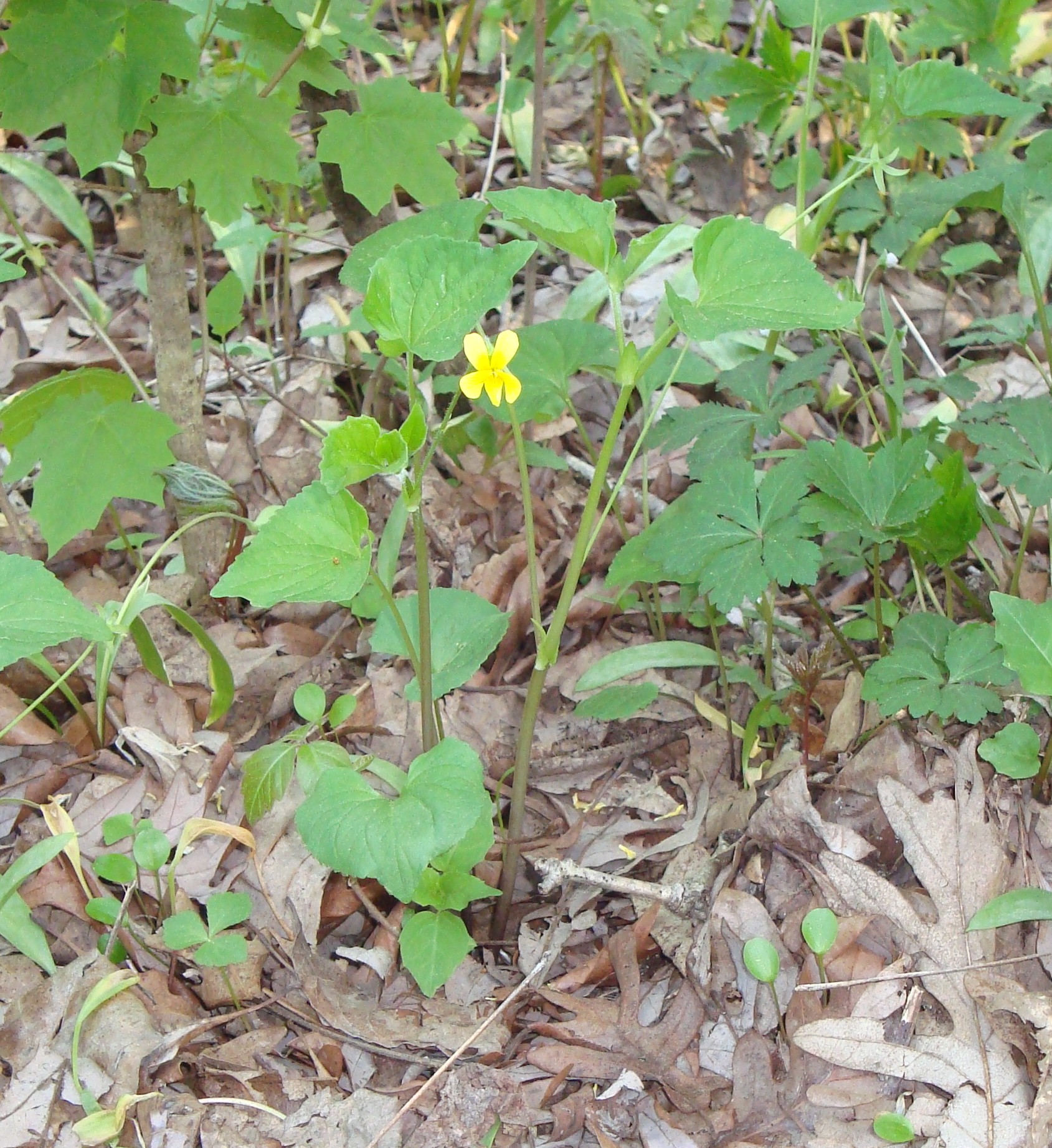
 Yellow violet

Yellow violet

Ramps (Allium tricoccum)
A real springtime indulgence, ramps are available only during a small window of time.

Also known as wild leeks, ramps are the best wild onion. In New Jersey, this seasonal delicacy appears in late March through the end of May. After this brief window of opportunity, ramp leaves turn yellow and melt away into the forest floor – so remember the spot and come back next year!

The underground bulbs are delicious, but over-harvesting of wild leeks is a serious threat to this native plant. In fact, ramps are now an endangered species in parts of Canada and several other parts of the continent, due to excessive picking by wild Allium aficionados.   Foragers who supply high-end restaurants with ramps are a specific concern. They have been known to destroy large populations of ramps, and pose a distinct threat to this species.

So please be a responsible forager.  When harvesting ramps, pick leaves only, leaving at least one leaf on each plant. Leaving most of the plant intact along with its root allows the plant to regenerate.   Pick a leaf here, a leaf there.

Chopped ramp leaves are great in egg dishes or mashed potatoes. Use them wherever you’d use scallions.

And ramps, along with other members of the Allium family including onion, scallions, garlic, leeks and chives, are nutritional good-guys. Whether wild or domesticated, they fight everything from cancer to heart disease to osteoporosis.

HOW TO IDENTIFY
You’ll find ramps growing in moist woodlands. Each plants bears 2 or 3 broad smooth leaves. The leaves and bulb have a distinct onion or garlic smell when bruised or crushed. Ramps have a scallion-like bulb. The lower stalk is white or reddish. Ramps occur in small clusters or if you’re lucky, in great big expanses.

CAUTIONS
Lily of the valley (Convallaria majlis) is a toxic look-alike to ramps. The leaves do look similar enough to cause confusion. To determine if it’s ramps you’ve got, sniff a crushed leaf or any part of the plant – it should smell distinctly of onion-garlic. Also check other identifying factors.

Ramps (left) and Lily of the Valley (right)

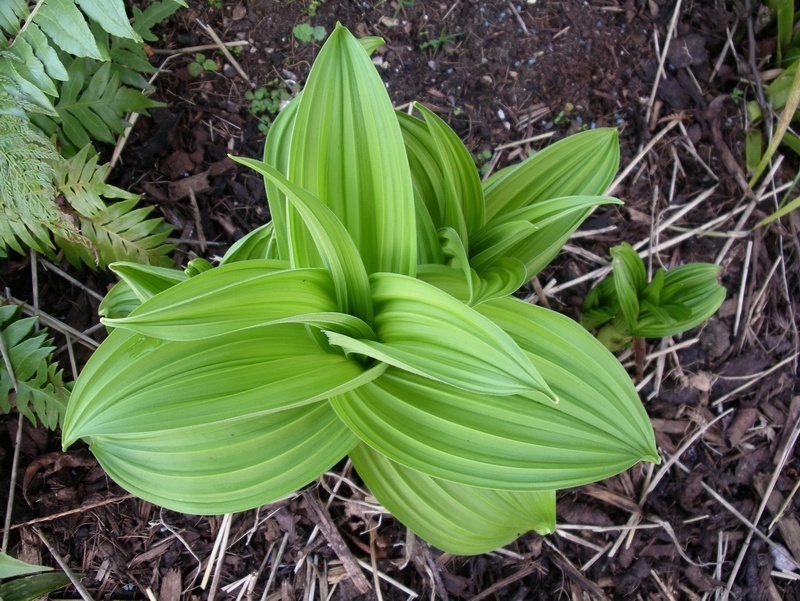
Also said to be a look-alike to ramps, poisonous False Hellebore (Veratrum viride) has pleated leaves, unlike the smooth leaves of ramps. False Hellebore doesn’t have the same onion-garlic odor as ramps. Also, the stalk of  False Hellebore elongates as the plant grows.

Be careful.

False hellebore

False hellebore

Common Greenbrier (Smilax rotundifolia)
One more “spring only” delight, the new growth of the tough greenbrier vine gives us surprisingly soft stems, baby leaves and tender tendrils and that make for a great trail nibble or a nice salad addition.

Heavily armed with stout thorns in the summer, greenbrier’s soft side surprises many people. When I mention that it’s one of my favorite springtime edibles I often hear people relate their unpleasant encounters with this thorny plant.
But when they pluck the soft growing tips and taste it they are won over by the unique flavor of greenbrier.

The soft edible parts are abundant in May and June.

Green brier

Greenbrier

To savor greenbrier all you have to do is break off anything that seems soft enough to eat, and enjoy.  You may even find yourself eating soft young thorns that haven’t hardened yet… I always get a kick out of doing this!

Or you can take a bunch of tips home and cook them up as you would green beans.

gg

Note heart-shaped leaves with parallel veins.

HOW TO IDENTIFY

You’ll recognize this plant by its thorns, climbing tendrils, and shiny heart-shaped leaves with smooth edges. The leaves have 3-5 parallel veins which radiate out from the base.

Happy foraging!